It's sometimes best not to know too much, but yet knowing is good at the same time. So, it's good I know, but what's next ? What to do ? Speak up or sit and hopes that someone realizes it ?
Fact that our relationship is complicated, complicates things further.
I'll probably just... Do what I do best.
Tuesday, December 25, 2012
Friday, December 7, 2012
Wednesday, September 12, 2012
A Thousand Words
Ever wonder what if everyone is given ONLY a thousand words before their lives are taken ? What would you do ?
Words uttered and written, at most time does not mean the truth and more often than not, pointless and overrated. People speak without thinking, hurting others without realization. Lies without commitments.
Speak of love, when there is no love. Speak of life, when really life isn't what it means. Speak of family, when friends often comes first. Says I will, when "will" will never exist...
Words uttered and written, at most time does not mean the truth and more often than not, pointless and overrated. People speak without thinking, hurting others without realization. Lies without commitments.
Speak of love, when there is no love. Speak of life, when really life isn't what it means. Speak of family, when friends often comes first. Says I will, when "will" will never exist...
Tuesday, August 21, 2012
Scream Bloody Murder in Cambodia
Ever thought of Cambodia as a developed country ? I've not, until I discovered that they could have been, if not of the communism brought by Khmer Rouge into the once peaceful and beautiful country of theirs.
Here goes the story...
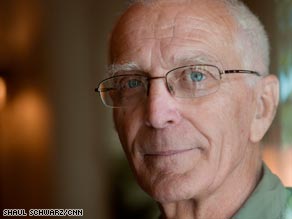
HNOM PENH, Cambodia (CNN) -- Francois Ponchaud was a newly ordained Catholic priest when he arrived in Cambodia in 1965 from a small village in France.
He was sent to do missionary work. But within a decade he would
become a crusader against the worst genocide since the Holocaust.
"I was staying by the Cambodian people's side," Ponchaud said, "through the good and the sadness and the suffering."
When he arrived at age 26, Cambodia was a peaceful place: a bucolic land of villages, peasants, rice paddies and Buddhist monks. Ponchaud studied Cambodian history and Buddhism, became fluent in Khmer, made friends and immersed himself in the culture -- falling in love with the country and its people.
But the peacefulness was short-lived.
By 1970, Cambodia was descending into chaos as the Vietnam War spilled across its borders. In the countryside, the Americans were carpet-bombing Vietcong outposts. In the capital, Phnom Penh, Washington was propping up a corrupt government.
From the jungles, a sinister and brutal communist rebel group called the Khmer Rouge was fighting to overthrow Cambodia's U.S.-backed regime.
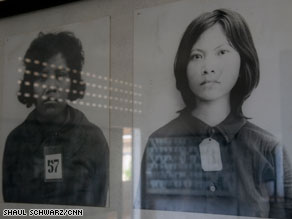
On April 17, 1975, Phnom Penh fell to the Khmer Rouge. They began to reinvent Cambodia according to an insane blueprint. They emptied the cities, including some 3 million in the capital, forcing all the residents into the countryside -- and toward a dark future.
"As of noon, all the people started leaving," Ponchaud said. "Then I saw all my friends who were leaving. ... There were hundreds of thousands of people who were trudging along a few kilometers an hour. It was truly a staggering sight. Incredible." Watch Ponchaud describe the exodus from Phnom Penh »
Ponchaud was told to stay at the French Embassy, where thousands fleeing Phnom Penh desperately sought asylum. One of the few foreigners able to communicate with the Khmer Rouge, he spent days at the embassy gate, trying to negotiate. Watch Ponchaud discuss the significance of the embassy gate »
In the weeks that followed, the Khmer Rouge let him leave the embassy twice. Both times he searched for clues about what was happening in the country. But Phnom Penh was empty. Read a reporter's notebook of his journey through Cambodia's killing fields »
Ponchaud was expelled from the city in the last evacuating convoy, as the Khmer Rouge forced all foreigners onto trucks and out of the country. At the border, Ponchaud broke down, weeping.
"It was as though we had gone mad," he said. "We were getting out of a country of the living dead."
With the country sealed, the Khmer Rouge went about creating their new Cambodia -- and the killing began in earnest.
The Khmer Rouge envisioned a return to Cambodia's medieval greatness -- a "pure" nation full of noble peasant farmers.
For that, though, they had to purge everyone else: the rich, the religious, the educated, anyone from a different ethnic group.
"All those who were opposed to the government were killed," Ponchaud said. "And all those who didn't work quite hard enough were killed."
Hundreds of thousands were worked -- or starved -- to death. "Perhaps a good chunk -- a solid half -- died from sickness and lack of health care," he said.
By September 1975, Ponchaud was back in France and ready to resume his work. His missionary society in Paris asked him to keep track of events in Cambodia. He quickly became the "go-to" person for Cambodian refugees arriving from Thailand, and he began documenting their stories.
At first, Ponchaud had a hard time believing the accounts of execution, torture, deportation, forced labor and starvation. Read how a Khmer Rouge survivor is documenting the genocide
"They were burning villages ... sending people into the forest without giving them anything to eat," Ponchaud said. "It went beyond my wildest imagination."
Horrified, Ponchaud devised a plan to gather more information: A friend living on the Cambodian border would record and send him broadcasts from Radio Phnom Penh -- the official voice of the Khmer Rouge -- in which the government described its transformation of the country. Read a former Khmer Rouge member's account of the killings
Ponchaud found that the broadcasts substantiated the refugees' claims. As unbelievable as those claims were, the broadcasts told of the same policies. What the refugees were saying was true.
"I decoded the radio -- the official declarations. And then the refugees would give me the 'experienced' side. It matched up," he said. "On one hand, the ideology, and on the other, the lived experience." Watch Ponchaud describe how he was able to decode the Khmer Rouge ideology »
For months, Ponchaud gathered and documented information, repeatedly denouncing the Khmer Rouge. His testimonials appeared in the French press as early as October 1975.
He also wrote to the president of France and Amnesty International, and appeared before the U.N. Commission on Human Rights. Watch Ponchaud discuss his efforts to alert people to the genocide »
In 1976, angered by inaccuracies in Le Monde's reporting on the Khmer Rouge, Ponchaud fired off a letter to the newspaper's editor -- along with a dossier of refugee accounts and radio transmissions. He was contacted immediately and asked to write for the newspaper. His articles were published in February 1976. Watch Ponchaud tell the Le Monde story »
Though few accounts of Cambodia's nightmare were appearing in the press, the U.S. government was receiving frequent briefings about what was happening there. In a meeting in November 1975, then-Secretary of State Henry Kissinger acknowledged the brutality of the Khmer Rouge. But he also knew that they shared an enemy with the U.S. -- Vietnam.
"Tell the Cambodians that we will be friends with them," Kissinger told an official in the region, according to a declassified State Department account. The Khmer Rouge "are murderous thugs," he said, "but we won't let that stand in our way." Read Kissinger's words in the declassified State Department document (pdf)
By 1977, the Khmer Rouge had been in power for two years, and much of the world remained unaware or uninterested. Many who did hear accounts of Khmer Rouge brutality found them hard to believe. Even prominent liberals and intellectuals doubted that a supposedly egalitarian peasant movement would perpetrate such horrors on their own people.
Ponchaud then published a startling book called "Year Zero." It was one of the first to expose the brutal totalitarian regime of the Khmer Rouge to the world. Still, no help came for Cambodia.
"I was pretty frustrated," he said. "The governments did not react. You know, countries don't defend human rights. They are always subservient to politics."
In January 1977, the inauguration of President Jimmy Carter promised a change. Carter vowed to put human rights at the center of U.S. foreign policy. But it would take 15 months for him to publicly condemn the Khmer Rouge as the world's "worst violator of human rights."
Even then he took no action to stop the slaughter. Invasion, he said, was not an option for a country still recovering from the Vietnam War.
Instead, in December 1978, Vietnam invaded Cambodia after years of cross-border skirmishes. The Vietnamese quickly overthrew the Khmer Rouge, who fled back into the jungle.
The world would finally start to see that all Ponchaud had said was true. More than 2 million Cambodians were dead. The scope of the catastrophe quickly became clear. In the fall of 1979, Carter responded, raising $32 million to help the refugees.
Today, Ponchaud is back in Cambodia, continuing his efforts for the
Cambodian people, building schools, holding Mass and working on local
projects. Often referred to as "the friend of the Cambodians," he is
considered an expert on the country. But this time he has no illusions.
Here goes the story...
HNOM PENH, Cambodia (CNN) -- Francois Ponchaud was a newly ordained Catholic priest when he arrived in Cambodia in 1965 from a small village in France.

"I was staying by the Cambodian people's side," Ponchaud said, "through the good and the sadness and the suffering."
When he arrived at age 26, Cambodia was a peaceful place: a bucolic land of villages, peasants, rice paddies and Buddhist monks. Ponchaud studied Cambodian history and Buddhism, became fluent in Khmer, made friends and immersed himself in the culture -- falling in love with the country and its people.
But the peacefulness was short-lived.
By 1970, Cambodia was descending into chaos as the Vietnam War spilled across its borders. In the countryside, the Americans were carpet-bombing Vietcong outposts. In the capital, Phnom Penh, Washington was propping up a corrupt government.
From the jungles, a sinister and brutal communist rebel group called the Khmer Rouge was fighting to overthrow Cambodia's U.S.-backed regime.
On April 17, 1975, Phnom Penh fell to the Khmer Rouge. They began to reinvent Cambodia according to an insane blueprint. They emptied the cities, including some 3 million in the capital, forcing all the residents into the countryside -- and toward a dark future.
"As of noon, all the people started leaving," Ponchaud said. "Then I saw all my friends who were leaving. ... There were hundreds of thousands of people who were trudging along a few kilometers an hour. It was truly a staggering sight. Incredible." Watch Ponchaud describe the exodus from Phnom Penh »
Ponchaud was told to stay at the French Embassy, where thousands fleeing Phnom Penh desperately sought asylum. One of the few foreigners able to communicate with the Khmer Rouge, he spent days at the embassy gate, trying to negotiate. Watch Ponchaud discuss the significance of the embassy gate »
In the weeks that followed, the Khmer Rouge let him leave the embassy twice. Both times he searched for clues about what was happening in the country. But Phnom Penh was empty. Read a reporter's notebook of his journey through Cambodia's killing fields »
Ponchaud was expelled from the city in the last evacuating convoy, as the Khmer Rouge forced all foreigners onto trucks and out of the country. At the border, Ponchaud broke down, weeping.
"It was as though we had gone mad," he said. "We were getting out of a country of the living dead."
With the country sealed, the Khmer Rouge went about creating their new Cambodia -- and the killing began in earnest.
The Khmer Rouge envisioned a return to Cambodia's medieval greatness -- a "pure" nation full of noble peasant farmers.
For that, though, they had to purge everyone else: the rich, the religious, the educated, anyone from a different ethnic group.
"All those who were opposed to the government were killed," Ponchaud said. "And all those who didn't work quite hard enough were killed."
Hundreds of thousands were worked -- or starved -- to death. "Perhaps a good chunk -- a solid half -- died from sickness and lack of health care," he said.
By September 1975, Ponchaud was back in France and ready to resume his work. His missionary society in Paris asked him to keep track of events in Cambodia. He quickly became the "go-to" person for Cambodian refugees arriving from Thailand, and he began documenting their stories.
At first, Ponchaud had a hard time believing the accounts of execution, torture, deportation, forced labor and starvation. Read how a Khmer Rouge survivor is documenting the genocide
"They were burning villages ... sending people into the forest without giving them anything to eat," Ponchaud said. "It went beyond my wildest imagination."
Horrified, Ponchaud devised a plan to gather more information: A friend living on the Cambodian border would record and send him broadcasts from Radio Phnom Penh -- the official voice of the Khmer Rouge -- in which the government described its transformation of the country. Read a former Khmer Rouge member's account of the killings
Ponchaud found that the broadcasts substantiated the refugees' claims. As unbelievable as those claims were, the broadcasts told of the same policies. What the refugees were saying was true.
"I decoded the radio -- the official declarations. And then the refugees would give me the 'experienced' side. It matched up," he said. "On one hand, the ideology, and on the other, the lived experience." Watch Ponchaud describe how he was able to decode the Khmer Rouge ideology »
For months, Ponchaud gathered and documented information, repeatedly denouncing the Khmer Rouge. His testimonials appeared in the French press as early as October 1975.
He also wrote to the president of France and Amnesty International, and appeared before the U.N. Commission on Human Rights. Watch Ponchaud discuss his efforts to alert people to the genocide »
In 1976, angered by inaccuracies in Le Monde's reporting on the Khmer Rouge, Ponchaud fired off a letter to the newspaper's editor -- along with a dossier of refugee accounts and radio transmissions. He was contacted immediately and asked to write for the newspaper. His articles were published in February 1976. Watch Ponchaud tell the Le Monde story »
Though few accounts of Cambodia's nightmare were appearing in the press, the U.S. government was receiving frequent briefings about what was happening there. In a meeting in November 1975, then-Secretary of State Henry Kissinger acknowledged the brutality of the Khmer Rouge. But he also knew that they shared an enemy with the U.S. -- Vietnam.
"Tell the Cambodians that we will be friends with them," Kissinger told an official in the region, according to a declassified State Department account. The Khmer Rouge "are murderous thugs," he said, "but we won't let that stand in our way." Read Kissinger's words in the declassified State Department document (pdf)
By 1977, the Khmer Rouge had been in power for two years, and much of the world remained unaware or uninterested. Many who did hear accounts of Khmer Rouge brutality found them hard to believe. Even prominent liberals and intellectuals doubted that a supposedly egalitarian peasant movement would perpetrate such horrors on their own people.
Ponchaud then published a startling book called "Year Zero." It was one of the first to expose the brutal totalitarian regime of the Khmer Rouge to the world. Still, no help came for Cambodia.
"I was pretty frustrated," he said. "The governments did not react. You know, countries don't defend human rights. They are always subservient to politics."
In January 1977, the inauguration of President Jimmy Carter promised a change. Carter vowed to put human rights at the center of U.S. foreign policy. But it would take 15 months for him to publicly condemn the Khmer Rouge as the world's "worst violator of human rights."
Even then he took no action to stop the slaughter. Invasion, he said, was not an option for a country still recovering from the Vietnam War.
Instead, in December 1978, Vietnam invaded Cambodia after years of cross-border skirmishes. The Vietnamese quickly overthrew the Khmer Rouge, who fled back into the jungle.
The world would finally start to see that all Ponchaud had said was true. More than 2 million Cambodians were dead. The scope of the catastrophe quickly became clear. In the fall of 1979, Carter responded, raising $32 million to help the refugees.
"No one defends human rights," he said. "Governments are cold beasts looking out for their own interests."
Sunday, May 6, 2012
Nothing, is ever enough.
Dear Script,
I've just made a most remarkably common discovery that is well known to every person by heart, but yet a lesson that cannot be learnt.
Greed, till this day, still haunts every individual's soul, regardless of how hard a person tells themselves to never greed.
Of course, we have extraordinary exceptions from people whom we believe stands above us ordinary beings.
Upon a person's death, loved ones, a sister and aunt we used to be calling for ages until the day she leaves us, most, if not all, would stand their ground to have an open discussion, or family "meeting" we so-called it as. It is to the extend, not exaggerated, that this discussion to be held before her dead body can leave the human's home, to her own home we call grave.
How is it human, for family to be doing so ? Mother nature taught us good, that family matters most than anything else possibly known valuable to us beings. I wonder, what taught us otherwise ?
What comes first, when a person is deceased, is generally the deceased's properties. Eyes on the paper that lawyer holds. Air filled with filthy languages and words from dissatisfaction of allocations. Heart broken, bonds tore apart. Nobody can we call family any more, because what is top priority is what everyone can get hold of, a wealth they have not been working for, money falling from the sky.
How is it that material wealth won over a bond that has been built forever ?
There is no such thing as equal distribution of the deceased's wealth, because it is never enough to accommodate everyone.
There is no such thing as fair share, as what is fair to her may not be fair to him.
Too much, and too little, who's to judge ?
What people never understood, is that there is no loss in material wise, because they never earned such wealth. What is lost, is a life more precious than anything else possibly found on earth. Unfortunately, this is never seen through the eyes of whom invites greed.
What is given to them, is never enough, never sufficient. Given a bone, they keep asking for more.
Such lesson cannot be learnt, not have I found anyone that could prove. Not my father and mother, not my relatives, not anyone I can look up to that could possibly impress me with an incident to prove greed can be cured.
The only person I could possibly think is near that stage, is the one person I loved more than any relatives I have. She's gone for good, for the power above brought her back to where she belongs. I have not got to know her much more, but I have spent incredible times with her.
Nothing can possible suffice the greed in a person. Nothing, is ever enough.
I've just made a most remarkably common discovery that is well known to every person by heart, but yet a lesson that cannot be learnt.
Greed, till this day, still haunts every individual's soul, regardless of how hard a person tells themselves to never greed.
Of course, we have extraordinary exceptions from people whom we believe stands above us ordinary beings.
Upon a person's death, loved ones, a sister and aunt we used to be calling for ages until the day she leaves us, most, if not all, would stand their ground to have an open discussion, or family "meeting" we so-called it as. It is to the extend, not exaggerated, that this discussion to be held before her dead body can leave the human's home, to her own home we call grave.
How is it human, for family to be doing so ? Mother nature taught us good, that family matters most than anything else possibly known valuable to us beings. I wonder, what taught us otherwise ?
What comes first, when a person is deceased, is generally the deceased's properties. Eyes on the paper that lawyer holds. Air filled with filthy languages and words from dissatisfaction of allocations. Heart broken, bonds tore apart. Nobody can we call family any more, because what is top priority is what everyone can get hold of, a wealth they have not been working for, money falling from the sky.
How is it that material wealth won over a bond that has been built forever ?
There is no such thing as equal distribution of the deceased's wealth, because it is never enough to accommodate everyone.
There is no such thing as fair share, as what is fair to her may not be fair to him.
Too much, and too little, who's to judge ?
What people never understood, is that there is no loss in material wise, because they never earned such wealth. What is lost, is a life more precious than anything else possibly found on earth. Unfortunately, this is never seen through the eyes of whom invites greed.
What is given to them, is never enough, never sufficient. Given a bone, they keep asking for more.
Such lesson cannot be learnt, not have I found anyone that could prove. Not my father and mother, not my relatives, not anyone I can look up to that could possibly impress me with an incident to prove greed can be cured.
The only person I could possibly think is near that stage, is the one person I loved more than any relatives I have. She's gone for good, for the power above brought her back to where she belongs. I have not got to know her much more, but I have spent incredible times with her.
Nothing can possible suffice the greed in a person. Nothing, is ever enough.
Subscribe to:
Posts (Atom)